THE BRØWSER
Content Hub
Shop
About
Publish with Us
  1. Home
  2. /
  3. content hub
  4. /
  5. blog

Borders, Memory, and Belonging in Amitav Ghosh's Literature

Borders, Memory, and Belonging in Amitav Ghosh's Literature

Some writers tell stories about places. Others tell stories about people. But in the works of Amitav Ghosh, places and people are inseparable. His novels ask a profound question: What happens when borders divide lands but cannot divide memory? Time and again, Ghosh returns to the invisible lines that shape human lives—national boundaries, cultural identities, family histories, and the memories that survive long after maps have been redrawn.

Whether he is writing about the Partition of India, colonial trade routes, migration across oceans, or communities threatened by climate change, Ghosh reminds readers that belonging is rarely simple. It is inherited, questioned, lost, and rediscovered. His literature suggests that home is often less about geography than about the stories people carry with them.

Also read: 7 Real Places Made Famous by Dan Brown’s Novels

→

What Writers Can Learn from Jhumpa Lahiri's Minimalist Prose

What Writers Can Learn from Jhumpa Lahiri's Minimalist Prose

There is a common misconception among aspiring writers that beautiful prose must be elaborate, that powerful stories are built with lush descriptions, dazzling vocabulary, and sentences that demand attention. But some of the most unforgettable writing achieves its impact in the opposite way. It whispers instead of shouting.

Few contemporary authors embody this better than Jhumpa Lahiri. Whether in Interpreter of Maladies, The Namesake, or Unaccustomed Earth, her prose is remarkably understated. She rarely relies on dramatic flourishes or lengthy descriptions. Instead, she crafts scenes with careful precision, allowing ordinary moments and seemingly insignificant details to reveal truths about love, identity, family, migration, and belonging.

For writers, her work teaches the art of saying more with less. In this article, we'll explore what writers can learn from Jhumpa Lahiri's minimalist prose—and how adopting some of her techniques can make your own writing clearer, more evocative, and ultimately more memorable.

Also Read:
From One Voice to Many: Understanding POVs in Fiction Writing

→

From One Voice to Many: Understanding POVs in Fiction Writing

From One Voice to Many: Understanding POVs in Fiction Writing

Every story has a voice. Sometimes it whispers directly into our ears. Sometimes it allows us to peer into a character’s thoughts. And sometimes it stands at a distance, observing events unfold like a silent witness. This voice—the lens through which a story is told—is known as the Point of View, or POV.

For readers, POV often works invisibly. We become so immersed in a story that we scarcely notice how it is being narrated. Yet for writers, choosing the right POV is one of the most important decisions in the storytelling process. It shapes how readers experience the plot, connect with characters, and interpret events.

A simple change in POV can transform the same story from an intimate confession into an epic saga. Understanding the different points of view is therefore not just a technical skill—it is an essential storytelling tool.

Also read: 7 Real Places Made Famous by Dan Brown’s Novels

→

7 Real Places Made Famous by Dan Brown’s Novels

7 Real Places Made Famous by Dan Brown’s Novels

If you've ever read a Robert Langdon thriller series and thought, "Wait, is this place actually real?", congratulations, you're onto Dan Brown's greatest superpower. The guy doesn't just write page-turning mysteries; he turns actual landmarks into characters that are just as important to the plot as the symbologists racing through them.

The locations Dan Brown chooses for his thrillers are very much real. And once you've read one of his books, you'll never look at these places the same way again. Brown treats cities like Florence, Paris, and Rome as more than just pretty postcards—they're puzzle boxes waiting to be solved. Whether you're a die-hard Dan Brown fan planning your next trip or just curious about which famous landmarks actually exist versus which ones are pure Brown magic, this list has you covered.

Let’s begin!

→

Rick Riordan Special: 10 Camp Half-Blood Moments Every Percy Jackson Fan Remembers

Rick Riordan Special: 10 Camp Half-Blood Moments Every Percy Jackson Fan Remembers

For many readers, Camp Half-Blood is more than just a fictional summer camp. It is a place that feels strangely real—a sanctuary hidden on Long Island, protected by magical borders, where demigods learn to survive in a world full of monsters, prophecies, and impossible quests. Long before Percy Jackson was battling Titans or sailing across the Sea of Monsters, he was simply a confused twelve-year-old trying to understand who he was. Camp Half-Blood became the answer.

Rick Riordan created a setting that readers instantly wanted to visit. Between the sword-fighting lessons, magical cabins, lava-climbing walls, and campfire sing-alongs, Camp Half-Blood felt like the ultimate home for anyone who had ever felt out of place.

Over the years, the camp has given fans countless unforgettable moments. Here are ten that remain etched in the memories of Percy Jackson readers everywhere.

Also read: Reading Slumps Are Real: Here Are 8 Books Guaranteed to Pull You Out of One

→

Pride Month Special: 10 Queer Indian Books That Explore Love, Identity & Belonging

Pride Month Special: 10 Queer Indian Books That Explore Love, Identity & Belonging

It’s the beginning of Pride Month, and around this time, meaningful conversations about queer love, representation, identity, and belonging often come to the forefront, creating a safe and celebratory space for these stories to be shared and appreciated. Books, literary classics, and contemporary works frequently become the heart of these discussions.

However, despite the growing visibility and celebrations, there are still many stories that remain overlooked and don’t receive the attention they deserve. Queer Indian narratives are among them.

This Pride Month, we’re shining a spotlight on queer representation in Indian literature—stories that explore love, self-discovery, identity, and belonging in uniquely Indian contexts. These books offer powerful perspectives, challenge conventions, and may leave you with a deeper understanding of experiences you may not have encountered before.

Also read: Genre in Publishing, Decoded: What Readers Look For and What Writers Must Deliver

→

You Think You Know Sherlock Holmes—But Do You? 7 Facts Even Devoted Readers Get Wrong

You Think You Know Sherlock Holmes—But Do You? 7 Facts Even Devoted Readers Get Wrong

He's one of the most recognisable characters in all of fiction. The deerstalker hat, the curved pipe, the sharp “Elementary, my dear Watson”, these images are burned into our cultural memory. Millions have read the stories, watched the adaptations, and will confidently tell you exactly who Sherlock Holmes is.

But here's the twist: much of what the world "knows" about Holmes didn’t actually come from Arthur Conan Doyle's pen. Over more than a century of stage plays, Hollywood films, and TV adaptations, the real Sherlock Holmes has been quietly replaced by a more convenient, more cinematic version—one that bears surprisingly little resemblance to the complex detective who first appeared in A Study in Scarlet in 1887. Even devoted readers who swear by the canon can get some of these wrong.

So, before you reach for that pipe and deerstalker, here are 7 things almost everyone believes about Sherlock Holmes—and why Conan Doyle would raise an eyebrow at every single one.

Also read: Genre in Publishing, Decoded: What Readers Look For and What Writers Must Deliver

→

8 Ruskin Bond Stories to Read on a Slow Afternoon (Ranked by Mood)

8 Ruskin Bond Stories to Read on a Slow Afternoon (Ranked by Mood)

Ruskin Bond is not a writer you read in a hurry. His stories do not demand anything of you. No suspense to chase, no shocking twists to brace for. They ask only that you sit still for a while, and in return, they offer something rare: the comforting feeling that the world is, at its core, still a gentle place.

And what better way to celebrate his birthday than by slowing down and letting his words quietly find you? Whether you’re feeling nostalgic, lonely, hopeful, or simply in need of a little calm, there’s a Ruskin Bond story that fits the mood perfectly.

Here are 8 Ruskin Bond stories to pick up on a slow afternoon—ranked by mood, so you can lose yourself in exactly the kind of feeling you need today.

Also read: 10 Children’s Books That Made Adults Cry (In the Best Way)

→

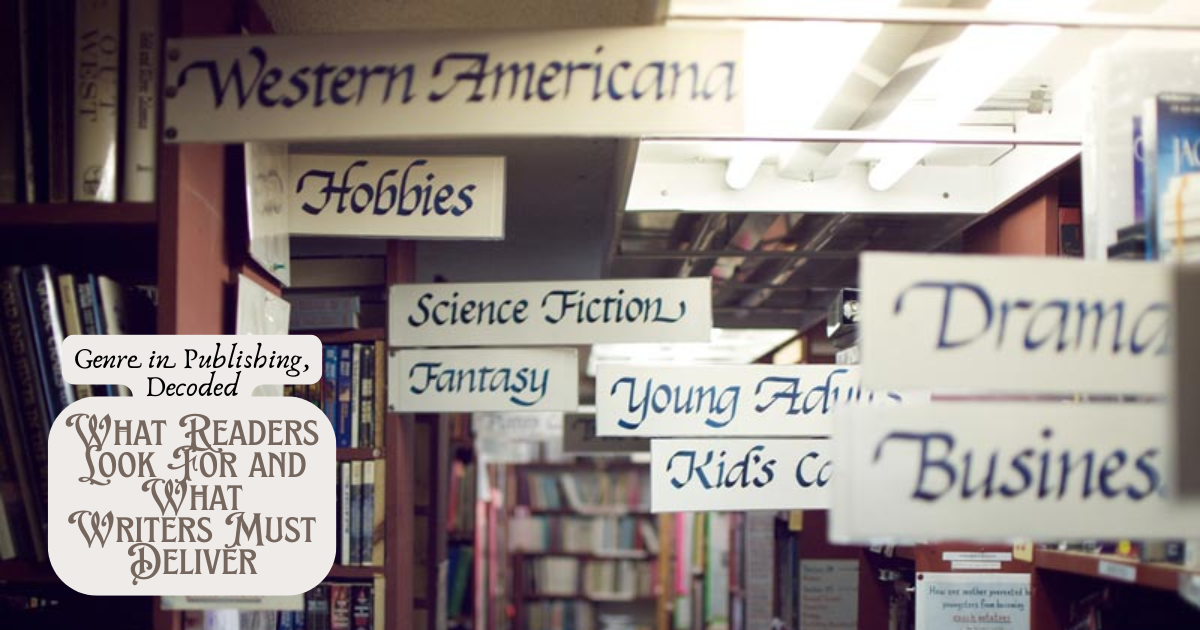
Genre in Publishing, Decoded: What Readers Look For and What Writers Must Deliver

Genre in Publishing, Decoded: What Readers Look For and What Writers Must Deliver

Walk into any bookstore, and you will notice something almost instinctive about the way books are arranged. Romance sits beside romance. Fantasy claims entire walls. Crime fiction gets its own darkly designed shelves. Literary fiction occupies a quieter corner, often dressed in minimalist covers and blurbs heavy with praise. Genre, in publishing, is not just a filing system. It is a promise.

For readers, genre answers a simple but powerful question: What kind of emotional experience am I about to have? For writers and publishers, it becomes a contract—sometimes liberating, sometimes restrictive, but always important. In today’s publishing ecosystem, where discoverability matters as much as craft, understanding genre is no longer optional. It is foundational.

Also read: 10 Children’s Books That Made Adults Cry (In the Best Way)

→

Reading Slumps Are Real: Here Are 8 Books Guaranteed to Pull You Out of One

Reading Slumps Are Real: Here Are 8 Books Guaranteed to Pull You Out of One

Every reader knows the feeling. You pick up a book, read three pages, and put it back down. Your ‘currently reading’ pile begins to look more decorative than functional. Stories that would once have consumed your weekends suddenly feel exhausting. A reading slump is not just about not reading; it is about losing the excitement of disappearing into another world.

Sometimes the problem is not attention span or lack of time. Sometimes you have simply not found the right book yet.

The best cure for a reading slump is rarely something overly demanding or emotionally distant. You need books that move. Books that whisper ‘just one more chapter’ at midnight. Books that remind you why stories mattered to you in the first place. Some do it through warmth, some through mystery, some through emotional honesty, and some through sheer unpredictability.

If your reading life feels stuck at the moment, these eight books might be exactly what you need.

→

Quote

Roald Dahl

So please, oh please, we beg, we pray, go throw your TV set away, and in its place you can install a lovely bookshelf on the wall.